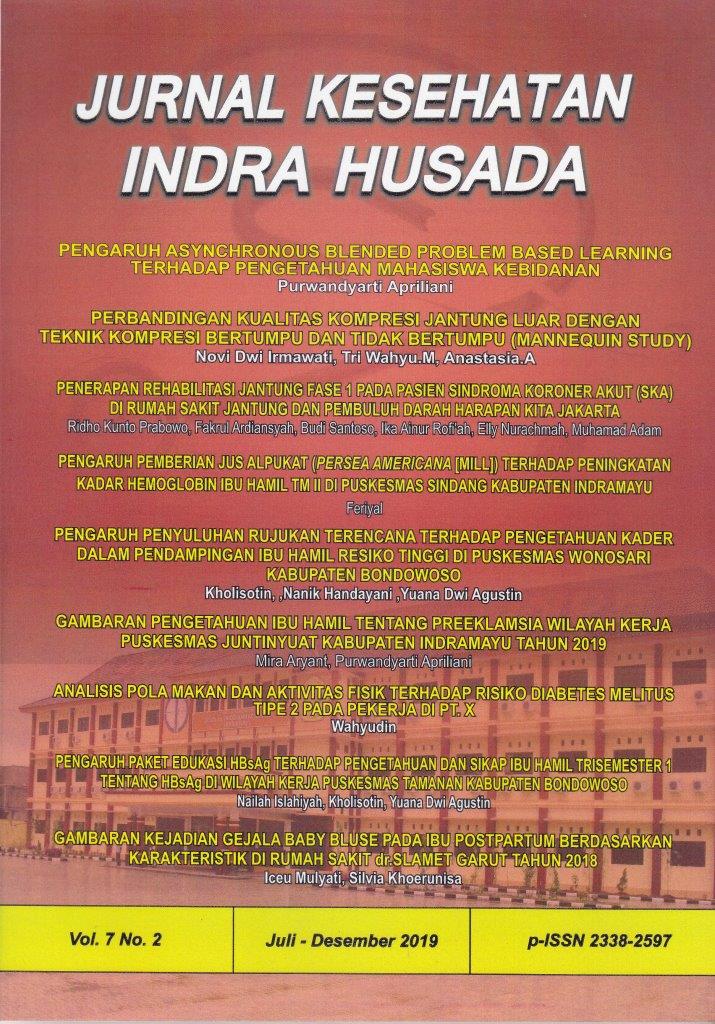
ANALYSIS OF DIETARY PETTERNS AND PHYSICAL ACTIVITY ON THE RISK OF TYPE 2 DIABETES MELLITUS IN WORKERS AT PT. X
DOI:
https://doi.org/10.36973/jkih.v7i2.180Kata Kunci:
Physical Activity, Dietary Petterns, Type 2 Diabetes Mellitus, Occupational HealthAbstrak
Diabetes is a non-infectious disease to 4 causes of death in Indonesia, prevalence of 6.9%, occurs at ≥ 15 years old (Kemenkes, 2014), Nearly 90% are Type 2 Diabetes Mellitus (T2DM) caused by unhealthy lifestyles. PT.X employees suffer from T2DM with a prevalence of 6.5%. The purpose of this study to analyze patterns of eating and physical activity of the patient DMT 2, with qualitative research methods of descriptive analysis on 12 respondents. The diet was measured by Food Frequency Quesionnair questionnaire and physical activity with International Physical Activity Quesionnair, and observation and in- depth interviews were conducted. The results showed that the characteristics of 12 respondents were ≥ 40 years old (75%), male (91.7%), and respondents who had a family history of DM (58.3%). Irregular eating patterns, excessive carbohydrate consumption or high Glycemic Index (GI). The activity of respondents in the category of mild and rarely exercise. Mean Total Metabolic Equivalent (MET) respondents from total work activities, transportation, domestic, exercise is below 600 MET-minutes/week, Respondents reasoned no time and lazy to exercise. Suggested health promotion programs on healthy or low GI foods for employees and their wives, if possible company provides healthy foods and create sports programs.
Unduhan
Referensi
Ali, O. (2013). Genetics of type 2 diabetes, 4(4), 114–123. https://doi.org/10.4239/wjd.v4.i4.114
Alva, M. L., Hoerger, T. J., Zhang, P., & Gregg, E. W. (2017). Identifying risk for type 2 diabetes in different age cohorts : does one size fit all ?, 1–7. https://doi.org/10.1136/bmjdrc-2017-000447
American Diabetes Association. (2017). STANDARDS OF MEDICAL CARE IN DIABETES -2017. Standards of Medical Care in Diabetes d 2017, 40(January).
Canada, P. H. A. of. (2011). the canadian diabetes risk questionnaire.
cde.drugabuse.go. (n.d.). Fagerstrom Test for Nicotine Dependence.
Cep, M. J. A., Colby, P., Kenny, G. P., Plotnikoff, R. C., Reichert, S. M., & Riddell, M. C. (2013). Physical Activity and Diabetes. Canadian Journal of Diabetes, 37, S40–S44. https://doi.org/10.1016/j.jcjd.2013.01.018
Daniels, S. R. (2012). Breakfast is important. The Journal of Pediatrics, 161(5), A1. https://doi.org/10.1016/j.jpeds.2012.09.029
Editorial, G. (2014). Defining Nutritious Breakfasts and Their Benefit. JOURNAL OF THE ACADEMY OF NUTRITION AND DIETETICS, 3–5. https://doi.org/10.1016/j.jand.2014.10.005
Hagströmer M, Oja P, S. M. (2008). The International Physical Activity Questionnaire (IPAQ): a study of concurrent and construct validity. Unit for Preventive Nutrition - Novum, Department of Biosciences, Karolinska Institutet, S-141 57 Huddinge, Sweden. Maria.Hagstromer@prevnut.Ki.Se.
Igusti Made Geria Jelantik, E. H. (2014). Hubungan faktor risiko umur, jenis kelamin, kegemukan dan hipertensi dengan kejadian diabetes melitus tipe 2 di wilayah kerja puskesmas Mataram. MediaBina Ilmiah 39, 8, 1.
IPAQ. (2005). Guidelines for Data Processing and Analysis of the International Physical Activity Questionnaire ( IPAQ ) – Short and Long Forms.
Jiao, J., Moudon, A. V, Kim, S. Y., Hurvitz, P. M., & Drewnowski, A. (2015). Health Implications of Adults ’ Eating at and Living near Fast Food or Quick Service Restaurants, 5(7), e171-6. https://doi.org/10.1038/nutd.2015.18
Kautzky-willer, A., & Pacini, G. (2016). Sex and complications of type 2 diabetes mellitus, (May), 1–42. https://doi.org/10.1210/er.2015-1137
Kemenkes. (n.d.). Pedoman Gizi Seimbang.
Kemenkes. (2014). Infodatin Diabetes 2014.pdf.
Liese, A. D., Ma, X., Maahs, D. M., & Trilk, J. L. (2013). Physical activity , sedentary behaviors , physical fitness , and their relation to health outcomes in youth with type 1 and type 2 diabetes : A review of the epidemiologic literature. Journal of Sport and Health Science, 2(1), 21–38. https://doi.org/10.1016/j.jshs.2012.10.005
Noor Hidayah, Pumono, D. F. (2015). Obesitas dan riwayat genetik dengan kejadian diabetes mellitus pada pada pengguna KB suntik depogestin di BPMHANDAYANI ISRO, desa Welahan. Jurnal Ummgl, 6, 3.
Odegaard, A. O., Pereira, M. A., Koh, W., Arakawa, K., & Lee, H. (2009). Coffee, tea, and incident type 2 diabetes: the Singapore Chinese Health StudyNIH Public Access. NIH Public Access, 88(4), 979–985.
PERKENI. (2015). Pengelolaan dan pencegahan diabetes melitus tipe 2 di indonesia 2015.
PT.X. (2017). Data Klinik Perusahaan Tahun 2017. Cirebon.
Rian Panelewen, Janette M. Rumbajan, L. S. (2017). Hubungan Usia Penyandang Diabetes Melitus Tipe 2 dan Disfungsi Ereksi. E-Biomedik (EBm), 5, 2.
Sunita Almatsier. (2002). Prinsip Dasar Ilmu Gizi. Jakarta: Gramedia Pustaka Utama.
Understanding, C. (2016). Relationship between Added Sugars Consumption and Chronic Disease Risk Factors : Current Understanding. https://doi.org/10.3390/nu8110697
Weickert, M. O., & Pfeiffer, A. F. H. (2018). Impact of Dietary Fiber Consumption on Insulin Resistance and the Prevention of Type 2 Diabetes, (January), 7–12. https://doi.org/10.1093/jn/nxx008
WHO. (2016). GLOBAL REPORT ON DIABETES.
Widyasari, N. (2017). HUBUNGAN KARAKTERISTIK RESPONDEN DENGAN RISIKO DIABETES. Jurnal Berkala Epidemiologi, 5(January 2017), 130–141. https://doi.org/10.20473/jbe.v5i1.
Willet W, Sampson L, S. M. (2015). Harvard Willett Food Frequency Questionnaire. Harvard T. H. Chan School of Public Health, Department of Nutrition.